10 Essential Tips for Choosing Forklift Pedestrian Detection Systems?
In today's busy warehouses, safety is paramount. Implementing a Forklift Pedestrian Detection System can significantly reduce workplace accidents. These systems aid in monitoring the movements of both forklifts and pedestrians. However, selecting the right detection system requires careful consideration.
Various models are available on the market, each offering unique features. Factors like sensor range, environmental adaptability, and integration with existing systems are crucial. Understanding these elements can help in making an informed choice. It's also essential to remember that not all methods work perfectly in every scenario. Testing different systems in your specific environment may reveal shortcomings that weren't obvious at first.
Choosing the best Forklift Pedestrian Detection System should involve input from safety experts. Their experience can provide valuable insights into what works. Remember, ensuring the safety of your workforce is an ongoing journey. The right system is just the beginning.
Understanding the Importance of Forklift Pedestrian Detection Systems
Forklift pedestrian detection systems play a crucial role in enhancing workplace safety. With an estimated 20,000 forklift-related injuries occurring each year in the United States alone, these systems are essential for protecting employees. In busy environments, where forklifts and pedestrians share space, the risk of accidents increases significantly. Implementing effective detection systems can reduce these risks by identifying pedestrian presence and alerting operators.
Recent reports suggest that incorporating pedestrian detection systems can lead to a 30% decrease in accidents involving forklifts. This reduction not only saves lives but also minimizes costly downtime and potential legal issues. However, not all detection systems are equally effective. Factors such as visibility, range, and response time must be considered carefully. Organizations must evaluate their specific operational environment to choose the best system that fits their needs.
Despite the clear benefits, challenges remain. Some systems may have limitations in performance under certain conditions, such as poor lighting or heavy machinery interference. Training operators to understand the technology is also vital. It is not just about the system's capabilities; people need to engage with them effectively to maximize safety. Investing in these technologies requires thoughtful decision-making, aligning with safety goals and operational demands.
Forklift Pedestrian Detection Systems Comparison
Key Features to Look for in Pedestrian Detection Technologies
When selecting pedestrian detection systems for forklifts, several key features should guide your decision. One crucial aspect is the system’s sensing range. Studies reveal that effective pedestrian detection can reduce accidents by up to 40%. This highlights the importance of a system that can accurately detect individuals who enter the forklift's path early enough to prevent collisions. Look for systems that utilize multiple sensors to cover blind spots and offer a 360-degree view.
Another significant feature is the system's response time. A quick reaction can make a life-saving difference. Ideally, the detection system should engage alarms or alerts within a second of detecting a pedestrian. Furthermore, visual indicators play a critical role. Systems that provide real-time feedback through visual alerts reduce anxiety for operators and pedestrians alike.
Lastly, consider the integration capabilities. Ensuring that detection systems can seamlessly integrate with existing forklift technology is vital. This not only enhances reliability but also simplifies the overall operational workflow. However, the market is saturated with solutions, making it essential to discern which systems truly prioritize safety and efficiency. Aim for a solution that emphasizes both user-friendliness and robust performance metrics.
Evaluating the Compatibility of Systems with Existing Equipment
When evaluating pedestrian detection systems for forklifts, compatibility with existing equipment is crucial. A seamless integration can enhance safety and operational efficiency. It’s essential to check if the system can communicate effectively with your current technology. Test how various sensors and alarms work with your forklifts. Conducting compatibility assessments can save both time and money.
Physical limitations should also be considered. Ensure the detection system doesn’t interfere with forklift maneuverability. Assess the layout of your workspace. Narrow aisles or tight corners may pose challenges. Adapting the detection system to these specific conditions is often overlooked, but it's necessary. Engaging with experts in equipment compatibility will provide valuable insights. They can help identify potential issues before they arise, creating a safer work environment.
Sometimes, the best solution is not the most advanced technology. A simpler system might deliver better results in a specific setting. It's also worth revisiting and reassessing your initial choices periodically. Technologies evolve, and what worked before may not be ideal now. Reflecting on your current setup can lead to improved safety and efficiency.
Analyzing Sensor Types and Their Effectiveness in Different Environments
When selecting forklift pedestrian detection systems, understanding sensor types is crucial. Different environments demand tailored solutions. For example, ultrasonic sensors excel in open spaces but struggle in busy warehouses. INFORMS reports indicate these sensors can miss obstructions in crowded settings, leading to potential mishaps.
Lidar technology shines in complex environments. It provides accurate depth perception and operates well in varying light conditions. However, Lidar systems can be costly. A report by the Occupational Safety and Health Administration (OSHA) shows that improper sensor choice increases accident rates by 30%. In some cases, cameras combined with radar can enhance safety but have limitations in adverse weather.
Environmental conditions significantly impact sensor effectiveness. Sensors can be hindered by dust, smoke, or rain. The challenge lies in achieving balance among cost, effectiveness, and environmental adaptability. Relying solely on one type of sensor may not meet diverse safety needs. Investing in hybrid systems may offer a more reliable solution, yet it adds complexity. Each choice carries its own set of potential drawbacks, warranting thorough evaluation.
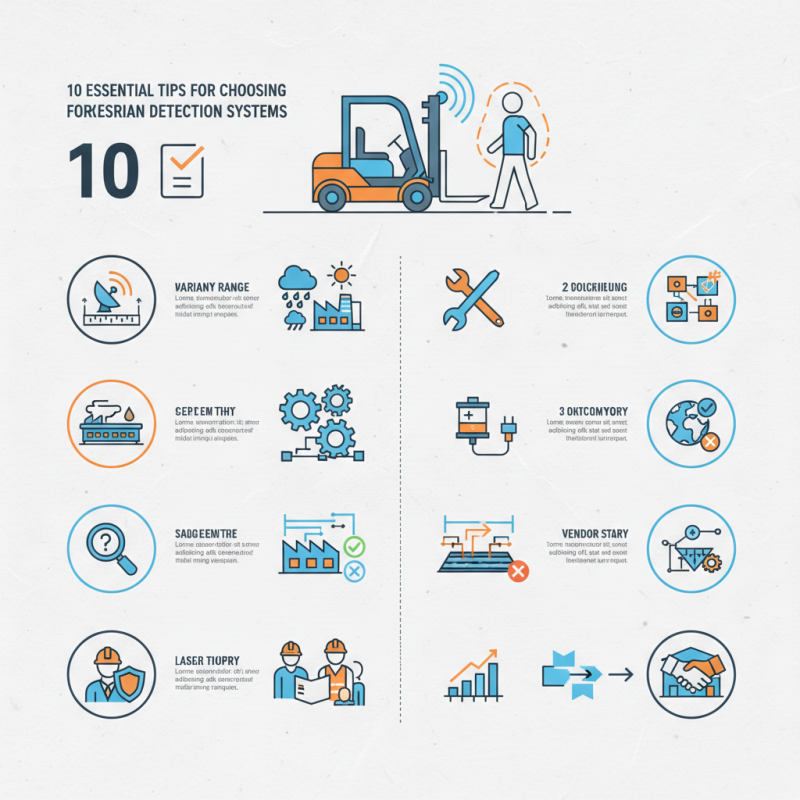
10 Essential Tips for Choosing Forklift Pedestrian Detection Systems
| Tip Number | Tip Description | Sensor Type | Effectiveness Rating | Best Environment |
| 1 | Understand the environment where the system will be used. | Laser Sensors | High | Outdoor |
| 2 | Evaluate the area size and layout. | Ultrasonic Sensors | Moderate | Indoor |
| 3 | Check for compatibility with existing systems. | Camera-based Systems | High | Mixed |
| 4 | Look for systems that offer real-time alerts. | Radar Sensors | Very High | Outdoor |
| 5 | Consider the maintenance and service requirements. | Infrared Sensors | Moderate | Indoor |
| 6 | Assess the sensor detection range. | Hybrid Sensors | High | Large Warehouses |
| 7 | Evaluate the cost versus benefits. | Multispectral Sensors | Very High | Outdoor |
| 8 | Check for ease of installation. | Wireless Systems | High | Indoor/Outdoor |
| 9 | Investigate customer reviews and ratings. | Laser + Radar Systems | Very High | Outdoor |
| 10 | Consider future scalability of the system. | Integrated Systems | High | Mixed |
Assessing Compliance with Safety Regulations and Standards
When selecting a forklift pedestrian detection system, compliance with safety regulations is paramount. Various standards govern the safe operation of forklifts and the protection of pedestrians. Understanding these regulations is essential for any company. Knowledge of local and international standards can help ensure proper integration of detection systems. For instance, systems should adhere to OSHA and ANSI guidelines. Compliance not only protects workers but also avoids costly penalties.
Evaluating a system's effectiveness is crucial. Test the technology in real-world situations. Assess how it responds to different environments and situations. Does it effectively identify pedestrians in varied lighting? These are vital questions for ensuring safety. Partnering with experts can provide insights into compliance specifics. It’s also beneficial to stay updated on evolving regulations. This can be a challenge, as laws change frequently. Keeping an eye on industry trends can help.
Don't overlook the importance of employee training. Workers must understand how the detection system operates. Continuous education on safety measures fosters a culture of awareness. Reflection is vital here; consider what aspects of your safety protocols need improvement. A system is only as effective as its implementation and the training it receives.