Top 5 Benefits of Using Brushed Motors for Your Projects?
In the world of robotics and automation, the choice of motor is crucial. Brushed motors have been a staple for many projects due to their reliability and simplicity. John Smith, a seasoned engineer at Tech Innovations, states, "Brushed motors provide unmatched performance and control for any application." This sentiment reflects the growing interest in understanding their benefits.
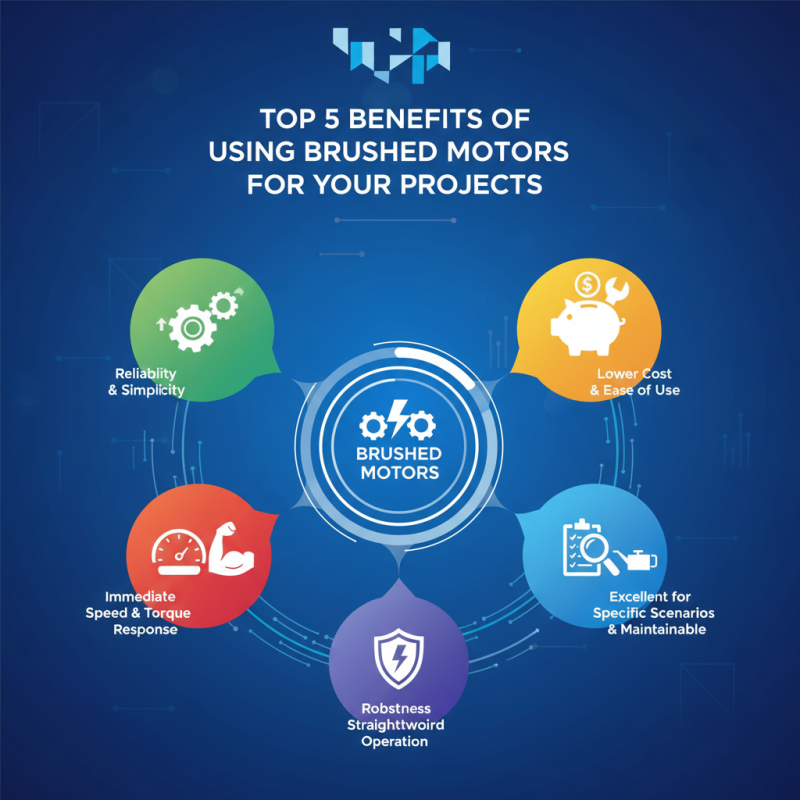
Brushed motors offer several advantages that can significantly enhance project outcomes. Their design allows for ease of use and lower costs, making them an attractive option for both professionals and enthusiasts. The immediate response in speed and torque can be vital in time-sensitive applications. However, they may require more maintenance than other types of motors, which is a key consideration for long-term projects.
Further exploration reveals that brushed motors excel in specific scenarios, where simplicity and robustness outweigh the need for advanced control features. Projects needing straightforward operation will find brushed motors valuable, although users must remain aware of their limitations. Understanding both the benefits and challenges of brushed motors enables better decision-making in project development.
Advantages of Brushed Motors in Various Applications
Brushed motors are widely used in various applications, offering several unique advantages. Their straightforward design makes them easy to control. These motors are ideal for projects that require precise speed and position control. For instance, in robotics, brushed motors can provide immediate feedback to adjust movements quickly. This responsiveness is crucial in environments where timing is everything.
One of the key benefits is their cost-effectiveness. Brushed motors are typically less expensive than their brushless counterparts. This affordability makes them popular for hobby projects and prototypes. However, they may require more frequent maintenance due to brush wear. This can be a downside for long-term applications. Users must consider this trade-off when selecting the right motor for their needs.
Efficiency can be another concern. While brushed motors deliver good performance, their energy consumption can be higher than expected. This inefficiency should be evaluated, especially for battery-powered projects. Ensuring optimal performance may require additional energy management strategies. Despite these challenges, the reliability and simplicity of brushed motors continue to make them a top choice for many engineers and hobbyists.
Enhanced Control and Precision with Brushed Motors
Brushed motors provide enhanced control and precision, which is vital in many projects. Their straightforward design allows for easy adjustments, making it simple to fine-tune performance. This flexibility is especially important in applications like robotics or automation, where precise movements are crucial.
With brushed motors, the direct connection between the power supply and the rotor enables quick response times. Users can achieve more accurate speed variations, often necessary for delicate tasks. However, this precision is not without its drawbacks; maintaining these motors requires regular attention, as wear can affect performance over time.
The simplicity of the brushed motor also means there can be trade-offs. While they are often easier to control, they may not be as efficient as brushless counterparts. As projects evolve, the need for thorough testing becomes evident, ensuring that the chosen motor continues to meet precision requirements. Balancing ease of use with long-term reliability is key in any successful implementation.
Cost-Effectiveness of Brushed Motors for Budget-Conscious Projects
Brushed motors provide a remarkable blend of cost-effectiveness for budget-conscious projects. According to a report from the International Electrotechnical Commission, brushed motors typically cost 30% less than their brushless counterparts. This price advantage makes them appealing for hobbyists and small-scale enterprises. Budget constraints often limit options, and brushed motors deliver reliable performance without sacrificing quality.
Furthermore, brushed motors are easier to maintain and replace. A study by the Institute of Electrical and Electronics Engineers highlights that these motors require less intricate designs, leading to lower manufacturing costs. The simplicity in their structure translates to reduced labor during assembly and maintenance. For projects where operational longevity is not critical, brushed motors present an excellent choice.
However, some might overlook potential drawbacks. Brushed motors can wear out faster due to brush and commutator friction, leading to higher long-term costs. It is essential to evaluate the specific needs of each project. While they may be cost-effective upfront, the long-term performance should be carefully considered. Understanding these nuances helps projects remain within budget while achieving desired outcomes.
Durability and Reliability Considerations for Brushed Motors
When considering brushed motors, durability and reliability emerge as key factors. These motors often outlive their competitors under certain conditions. A report from the International Journal of Electrical Engineering reveals that brushed motors can maintain excellent performance for over 10,000 operational hours. This is particularly beneficial for continuous-use applications like robotics and automotive systems.
However, it’s crucial to note that the lifespan of a brushed motor can vary significantly based on usage conditions. High load applications can lead to faster wear of brushes. Environmental factors, such as dust and humidity, also play a role. Industry data suggests that motors used in clean environments show a 20% longer lifespan compared to those in harsher conditions.
Regular maintenance is essential for reliability. Even with high durability ratings, brushes need periodic replacement. Motoring experts recommend monitoring brush wear closely. Neglecting this can result in unexpected failures. A study from the IEEE reveals that approximately 30% of motor failures in industrial settings stem from inadequate maintenance practices. This statistic highlights the balance between durability and the need for ongoing care.
Top 5 Benefits of Using Brushed Motors for Your Projects
This chart illustrates the top five benefits of using brushed motors in projects, rated on a scale from 1 to 10. The ratings reflect their cost-effectiveness, design simplicity, torque capabilities, availability, and ease of maintenance, highlighting why brushed motors remain a popular choice in various applications.
Ease of Maintenance and Repair for Brushed Motors in Use
Brushed motors are widely favored in various projects due to their simplicity. One key advantage is how easy they are to maintain and repair. Unlike more complex motor types, brushed motors have fewer components. This makes it straightforward to identify issues and replace worn-out parts.
Tips for maintenance include regularly checking brushes for wear. Replacing brushes can enhance motor lifespan significantly. Keep the commutator clean to ensure smooth operation. Inspecting for dust buildup can also prevent overheating. Regular maintenance can save time and costs in the long run.
However, it's important to acknowledge that maintenance still requires diligence. Ignoring minor issues can lead to bigger problems. A well-maintained brushed motor can last for years, but neglect can shorten its life. Establishing a maintenance schedule is crucial for keeping these motors running efficiently. Make sure to document repairs and inspections for better tracking.
Top 5 Benefits of Using Brushed Motors for Your Projects
| Benefit | Description | Example Applications |
| Ease of Maintenance | Brushed motors are typically easier to maintain as they have simple designs that allow for quick inspections and repairs. | Robotic systems, toys, and household appliances. |
| Cost-Effectiveness | Brushed motors are generally less expensive to produce and purchase, making them a cost-effective option for many projects. | DIY projects, low-budget electronics, and prototyping. |
| Simplicity of Design | Their straightforward design makes them easy to integrate into various systems without complex control mechanisms. | Fans, small pumps, and heating units. |
| High Starting Torque | Brushed motors provide high starting torque, beneficial for applications requiring immediate power-up. | Electric bikes, power tools, and conveyor systems. |
| Versatility | They can be used in a wide range of applications, across different industries due to their adaptability to various loads and sizes. | Automated systems, medical devices, and model engineering. |